{{ list.is_on_list ? 'Remove from' : 'Add to' }} favorites


There is a green hill in a far-away country
- 1334
THERE IS A GREEN HILL IN A FAR-AWAY COUNTRY;
it stands near a city outside a wall,
where Jesus our Saviour, the King of all glory,
suffered and died to save us all.
2 I may not know of the pain of his passion,
but I believe that in my place he stood,
that I may know freedom and live in forgiveness,
for I am redeemed by his great love.
There was no other good enough,
willing to pay the price of sin.
For he was the only one who could reach out
and unlock the gates of heaven to let us in.
3 So very dearly Jesus has loved us,
and all he would ask is that we love him too,
and trust him for all that this life lays before us,
that we would try his work to do.
There was no other good enough,
willing to pay the price of sin.
For he was the only one who could reach out
and unlock the gates of heaven...
There was no other good enough,
willing to pay the price of sin.
For he was the only one who could reach out
and unlock the gates of heaven to let us in.
© 2001 LITTLE ROOM MUSIC adm. by IQ MUSIC LTD
ORIGINAL WORDS: CECIL FRANCES HUMPHREYS ALEXANDER 1818–1895
ADAPTED WORDS: DAVID CLIFTON, IAN DAVID BLYTHE, PHIL BAGGALEY
CCLI: 3619579
3d. The Son - His Suffering and Death
Downloadable Items
Would you like access to our downloadable resources?
Unlock downloadable content for this hymn by subscribing today. Enjoy exclusive resources and expand your collection with our additional curated materials!
Subscribe nowIf you already have a subscription, log in here to regain access to your items.
Tune
-
There is a green hill in a far-away country (Irregular) 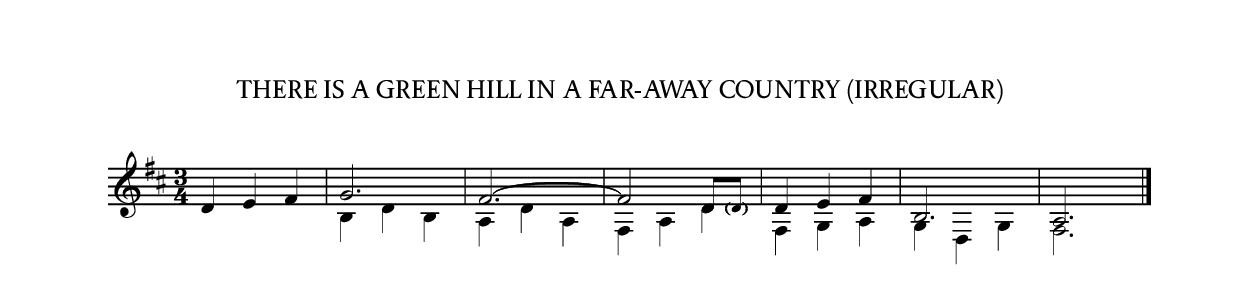
Composer: - David Clifton, Ian David Blythe, Phil Baggaley
A look at the authors
Alexander, Cecil Frances
b Eccles St, Dublin 1818; d Derry (Londonderry), N Ireland 1895. Born C F Humphreys, given 2 family names (the first given in some reference books as ‘Cecilia’, an understandable error) but always known as Fanny, she showed promise as a writer of verse (stories, amusements, devotions) from her early years. These could be sacred, sentimental, or witty; though never musical, she had a keen sense of sound and rhythm combined with a love of nature and the desire to be a good Anglican. In 1825 the family moved to Redcross, Co Wicklow (the date and place sometimes given for her birth), a ‘lost paradise’ and at that time a private riverside full of wildlife, and in 1833 to the more Protestant neighbourhood of Strabane, in Co Tyrone just south of Londonderry. Deaths in the family, and of 3 teenage sisters who were her friends, left a permanent shadow but also deepened her Christian faith and understanding. Pursuing her studies at home, she developed a good memory and became a fluent French speaker and keen reader. Through the sober godliness of her family and the upper-class company they kept, she ‘cherished into maturity an unshakeable faith in the natural goodness of the nobility’—V Wallace. Yet she also witnessed desperate poverty at first hand, while moving confidently among local and visiting clergy, who took her abilities and conversation seriously and without condescension. She remained most at home with small children and animals, notably dogs; and with her younger sister Anne (Annie) began a lifelong concern for deaf children and those with similar difficulties. Many of her royalties helped to support their care and education. Her frequent travels took her to Scotland and England as well as throughout Ireland.
As for her writing, Verses for Holy Seasons was published in 1846, followed by several other collections including Moral Songs (consciously echoing Watts?) and in 1848 Hymns for Little Children which ran to over 100 editions. By this book she was known; thus Walsham How, listing in a letter of 1869 his fellow guests at the home of the Bp of Oxford, includes ‘the Bishop of Derry with Mrs Alexander (“Hymns for Little Children
204, 372, 437, 842, 857.